


⚛️ Atom Computing: Scaling Quantum with 1,225 Neutral Atoms
From optical tweezers and nuclear-spin qubits to 24 entangled logical qubits with Microsoft—how Atom Computing’s neutral-atom platform is challenging the superconducting duopoly and accelerating the race to fault-tolerant quantum computing
⚡ TL;DR — Why Atom Computing Matters in 2025
- Scale Leader: 1,225-qubit AC1000 system delivered in 2025—largest commercially available neutral-atom quantum computer.
- Microsoft Partnership: November 2024 announcement: 24 entangled logical qubits (record), Azure Quantum integration, commercial deployment starting 2025.
- DARPA QBI Stage B: Selected in November 2025 alongside IBM, Google, IonQ for $15M+ funding to explore utility-scale quantum computing.
- Neutral-Atom Advantage: Long coherence (tens of seconds), mid-circuit measurement with immediate reset, straightforward 10× scaling per generation.
- Logical Qubit Breakthrough: Demonstrated 64-logical-qubit architecture, 24 entangled, ran 28-logical-qubit algorithm—proving error correction viability.
- Global Deployments: EIFO/Novo Nordisk Foundation (Denmark), University of Colorado Anschutz (healthcare), NREL (energy grid), Microsoft Azure Quantum (cloud).
- Technology Moat: Optical tweezers + optical cavities enable rapid scaling without physical footprint/power growth. Sustainable quantum computing.
🌌 Introduction: The Neutral-Atom Revolution
For years, superconducting qubits have dominated the quantum computing landscape—IBM’s modular chips, Google’s error-correction milestones, Rigetti’s fabrication advances. But in late 2025, a different architecture is rapidly gaining ground: neutral-atom quantum computing.
Atom Computing, a Berkeley-based startup founded in 2018 by Dr. Ben Bloom and Dr. Jonathan King, has emerged as the leader in this space. Their breakthrough: 1,225 fully-connected qubits in the AC1000 system, enabled by optical tweezers that trap individual strontium and ytterbium atoms in programmable 2D/3D arrays.
“Atom Computing has recently become a leading contender in the race to fault-tolerant quantum computing because of its straightforward ability to scale to the performance levels required for operating at the FTQC level.” — Atom Computing Whitepaper 2025
What makes neutral atoms different?
- Scalability: Atom Computing achieved 10× qubit growth from Gen 1 (100 qubits) to Gen 2 (1,225 qubits). Roadmap targets another 10× per generation—12,000+ qubits by Gen 3.
- Long Coherence: Nuclear-spin qubits preserve quantum information for tens of seconds (vs. 100-200 μs for superconducting qubits), reducing errors and simplifying error correction.
- Full Connectivity: Optical tweezer arrays enable any-to-any qubit interactions, unlike fixed grid topologies in superconducting systems.
- Sustainability: As systems scale, physical footprint and energy consumption remain relatively constant—no need for massive dilution refrigerators or facility upgrades.
In November 2024, Atom Computing partnered with Microsoft to deliver 24 entangled logical qubits—the highest number on record at the time. This system will be commercially available via Azure Quantum in 2025, marking a major milestone in the transition from physical qubits to fault-tolerant logical qubits.
In November 2025, DARPA selected Atom Computing for Stage B of its Quantum Benchmarking Initiative (QBI), awarding up to $15 million to accelerate neutral-atom technology toward utility-scale applications.
This deep-dive explores how Atom Computing’s technology works, why neutral atoms are challenging the superconducting duopoly, and what the 2025-2030 roadmap holds for this rising quantum computing contender.
🔬 Part 1: How Neutral-Atom Quantum Computing Works
1.1 The Physics: Optical Tweezers and Rydberg States
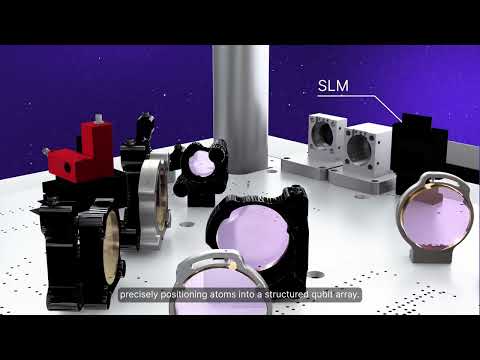
Optical Tweezers are the foundation of Atom Computing’s platform. These are tightly focused laser beams that create “traps” capable of holding individual neutral atoms in place.
How it works:
- Laser Focusing: A laser beam passes through a microscope objective lens, creating a highly concentrated point of light.
- Light-Atom Interaction: At the right wavelength, the intensity gradient creates an attractive force that draws atoms toward the focal point.
- Tweezer Array: By manipulating the laser beam (using acousto-optic deflectors or spatial light modulators), hundreds to thousands of optical tweezers can be created simultaneously in programmable 2D or 3D configurations.
Why Alkaline Earth Atoms (Strontium, Ytterbium)?
Atom Computing uses strontium-87 (Sr-87) and ytterbium-171 (Yb-171) because these alkaline earth atoms have unique properties:
- Nuclear Spin: The qubit is encoded in the spin of the atom’s nucleus (clockwise vs. counterclockwise). This choice is rare in quantum computing and provides two major advantages:
- Insensitivity to Noise: The nucleus is shielded from external electromagnetic noise, allowing for very long coherence times.
- No Spontaneous Decay: Unlike electronic states, nuclear-spin qubits don’t decay to lower energy states, meaning infinite theoretical memory if noise is controlled.
- Optical Toolbox: Alkaline earth atoms support advanced optical techniques (two-photon transitions, narrow-linewidth lasers) that enable precise control and measurement.
🔹 Key Technology #2: Rydberg Interactions for Two-Qubit Gates
To perform quantum operations between qubits, Atom Computing uses Rydberg states—highly energized states where the atom’s electron orbits far from the nucleus.
Process:
- Excitation: A laser pulse excites an atom from its ground state to a Rydberg state.
- Interaction: In the Rydberg state, the atom’s electron cloud is so large that it “reaches out” and interacts strongly with nearby atoms (even at micrometer distances).
- Entanglement: This interaction creates quantum entanglement between qubits, enabling two-qubit gates (e.g., controlled-NOT, controlled-Z).
- Return to Ground State: After the gate operation, atoms return to their ground state, preserving quantum information in the nuclear spin.
Advantage: Rydberg-mediated gates can be performed between any pair of qubits in the array by selecting which atoms to excite—achieving full connectivity without physical wiring.
1.2 Inside the AC1000 System: From Oven to Computation
Atom Computing’s second-generation platform (AC1000) uses a multi-vacuum chamber design:
🔹 Chamber 1: Atom Source and Cooling
- Oven: A solid sample of alkaline earth metal (strontium or ytterbium) is heated, creating a hot stream of atoms.
- Laser Cooling: A combination of lasers and magnetic fields rapidly cool and slow down the atoms to near absolute zero, bringing them almost to a complete stop.
- Optical Elevator: A pair of laser beams transport the cold atoms from Chamber 1 to Chamber 2.
🔹 Chamber 2: Quantum Computation
- Reservoir Array: Cooled atoms are parked in an auxiliary optical tweezer array called the “reservoir,” which can be reloaded at any time.
- Computing Array: Atoms are shuttled from the reservoir to the main computing array, which can hold up to 1,225 atoms in Gen 2 systems.
- Quantum Circuit Execution:
- Single-Qubit Gates: Site-specific laser pulses manipulate individual qubits. Gates can be executed in parallel across rows, increasing computational efficiency.
- Two-Qubit Gates: Rydberg excitation creates entanglement between qubit pairs.
- Mid-Circuit Measurement: Specific qubits can be measured without disturbing others, enabling real-time error detection.
- Readout: At the end of the circuit, a camera detects optical fluorescence from qubits, revealing the computation result as a pattern of 1s and 0s.
- Immediate Reset: Qubits are reinitialized and ready to run another quantum circuit without reloading the entire array—a major speed advantage.
🔧 Key Technology #3: Optical Cavities for Massive Scaling
Atom Computing’s Gen 2 systems introduce optical cavities—resonant structures that trap light and create standing wave patterns. These cavities enable:
- Scalable Light Fields: Instead of individual focused beams, optical cavities create periodic light fields that can trap many more atoms.
- Orders of Magnitude Growth: Cavity-based systems support 10,000+ qubits without proportional increases in laser power or optical complexity.
- Published Work: Norcia et al., “Iterative Assembly of Yb-171 Atom Arrays with Cavity-Enhanced Optical Lattices,” PRX Quantum, 2024.
Impact: This innovation paves the way for Gen 3 systems targeting 12,000-15,000 qubits by 2026-2027.
1.3 Software Stack: Control Systems and Qubit Virtualization
Atom Computing develops proprietary control systems that orchestrate all operations within the quantum platform:
- Pulse Compilation: Quantum circuits are compiled into precise timing sequences for lasers, imagers, magnets, and electro-optical components.
- Mid-Circuit Measurement: Real-time error detection identifies which qubits have errors, enabling logical branching to determine future operations.
- Atom Loss Detection: One challenge with neutral atoms is that they sometimes disappear (escape from traps). The control system detects luminescence to check if atoms are present and corrects for losses without halting computation.
Microsoft Integration: Atom Computing’s hardware integrates with Microsoft’s Azure Quantum virtualization system, which provides:
- Qubit Virtualization: Abstracts physical qubits into logical qubits, optimizing error correction for neutral-atom hardware.
- Hybrid Workflows: Seamless integration with classical HPC and AI resources on Azure.
- Cloud Access: Developers can access Atom Computing’s systems through Azure Quantum without managing hardware directly.
🏆 Part 2: 2024-2025 Breakthroughs and Milestones
2.1 Record: 24 Entangled Logical Qubits with Microsoft (November 2024)
In November 2024, Microsoft and Atom Computing announced a major breakthrough: 24 entangled logical qubits—the highest number on record at the time.
“By coupling our state-of-the-art neutral-atom qubits with Microsoft’s qubit-virtualization system, we are now able to offer reliable logical qubits on a commercial quantum machine.” — Ben Bloom, Founder & CEO, Atom Computing
Technical Details:
- Architecture: 20 logical qubits created from 80 physical qubits (4:1 encoding ratio).
- Algorithm: Successfully ran the Bernstein-Vazirani algorithm, which demonstrates quantum superposition and interference. While this is a proof-of-concept algorithm, it validates that logical qubits can perform computations with better-than-physical fidelity.
- Atom Loss Correction: The system repeatedly detected when neutral atoms disappeared and corrected for losses without halting computation—a first in quantum computing.
- Error Suppression: Logical qubits showed performance improvements over physical qubits, confirming that error correction is working as intended.
Why This Matters:
- Commercial Viability: Logical qubits are the foundation of fault-tolerant quantum computing. This demonstration proves neutral atoms are ready for early commercial applications.
- Microsoft Partnership: Azure Quantum’s integration provides cloud access, making Atom Computing’s technology accessible to researchers and enterprises globally.
- Competitive Positioning: At the time of announcement, this surpassed competitors like Quantinuum (12 logical qubits with Microsoft in September 2024).
2.2 AC1000 System: 1,225 Qubits Commercially Available (2025)
Atom Computing’s second-generation system, AC1000, entered commercial deployment in 2025:
| Specification | AC1000 (Gen 2) | First-Gen System |
|---|---|---|
| Physical Qubits | 1,225 (fully-connected) | ~100 |
| Qubit Type | Nuclear-spin (Yb-171, Sr-87) | Nuclear-spin |
| Coherence Time | Tens of seconds | Tens of seconds |
| Array Filling | >99% (nearly perfect) | ~95% |
| Mid-Circuit Measurement | Yes, with immediate reset | Yes |
| Logical Qubits | 64-logical-qubit architecture demonstrated; 50+ commercial offering | N/A |
| Cloud Access | Microsoft Azure Quantum | Limited |
| On-Premise Availability | Yes (2025 rollout) | No |
Key Innovations in AC1000:
- Optical Cavities: Cavity-enhanced optical lattices enable scalable atom loading and manipulation (Norcia et al., PRX Quantum 2024).
- High-Fidelity Gates: Two-qubit gates using Rydberg states achieve fidelities >99% (Muniz et al., arXiv 2024).
- Real-Time Error Correction: Mid-circuit measurement with microsecond latency enables dynamic error correction during computation.
2.3 DARPA QBI Stage B Selection (November 2025)
In November 2025, DARPA selected Atom Computing for Stage B of its Quantum Benchmarking Initiative (QBI). The program aims to determine if an industrially useful quantum computer—one whose computational value exceeds its cost—can be developed by 2033.
Stage B Details:
- Funding: Up to $15 million over one year
- Goal: Demonstrate utility-scale quantum operations with neutral-atom systems
- Competition: 11 companies advanced to Stage B, including IBM, Google, IonQ, Quantinuum, QuEra (also neutral-atom)
- Evaluation Criteria: Cost-effectiveness, scalability, application-specific performance (not just raw qubit count)
“Atom Computing has demonstrated utility-scale quantum operations and attracted attention from DARPA. The QBI program will accelerate our roadmap toward fault-tolerant systems.” — Atom Computing Press Release, November 2025
Why DARPA Selected Atom Computing:
- Scalability: 10× qubit growth per generation is unmatched among competing platforms
- Logical Qubit Progress: 24 entangled logical qubits and 28-logical-qubit algorithm execution demonstrate readiness for error correction
- Sustainability: Neutral-atom systems scale without massive physical footprint or energy consumption increases
2.4 Global Deployments: Denmark, Healthcare, Energy
Atom Computing systems are being deployed worldwide for research and commercial applications:
🔹 QuNorth: Denmark Partnership (July 2025)
- Partners: EIFO (European Interdisciplinary Forum) and Novo Nordisk Foundation
- System: “World’s Most Powerful Quantum Computer” at deployment—AC1000 with 1,225+ qubits
- Location: Nordic region’s first Level 2 (Resilient) quantum system
- Applications: Drug discovery, materials science, healthcare optimization
🔹 University of Colorado Anschutz: Healthcare Applications
- Focus: Quantum computing for healthcare—diagnostics, personalized medicine, drug interaction modeling
- Partnership Announcement: 2024
- Goal: Explore quantum algorithms that can handle complex biological datasets
🔹 NREL (National Renewable Energy Laboratory): Energy Grid
- Focus: Quantum computers interfacing with power grid equipment
- Announcement: 2023 (early partnership)
- Applications: Grid optimization, renewable energy integration, disaster response
💡 AI Prompt: Compare Neutral-Atom vs. Superconducting Qubits
Prompt: “Create a detailed comparison table between neutral-atom quantum computing (like Atom Computing) and superconducting quantum computing (like IBM Quantum) covering: coherence time, gate fidelity, scalability, connectivity, operating temperature, physical footprint, and error correction readiness. Include pros and cons for each approach.”
⚔️ Part 3: Atom Computing vs. The Quantum Field
3.1 Neutral-Atom Competitors: QuEra, Pasqal, Infleqtion
Atom Computing is not alone in the neutral-atom space. Several competitors are advancing similar technology:
| Company | Location | Qubits (2025) | Key Differentiator |
|---|---|---|---|
| Atom Computing | USA (Berkeley, CA) | 1,225 | Nuclear-spin qubits; Microsoft partnership; 24 logical qubits; DARPA QBI Stage B |
| QuEra Computing | USA (Boston, MA) | 256 (Aquila on Amazon Braket) | Public cloud access; analog quantum simulation; Harvard spinout; DARPA QBI Stage B |
| Pasqal | France (Paris) | 100-200 (various systems) | European focus; on-premise deployments; Aramco partnership (200-qubit Dhahran system) |
| Infleqtion | USA (Boulder, CO) | ~100 (focus on sensing) | Quantum sensing and navigation; atomic clocks; RF apertures; dual focus (computing + sensing) |
Atom Computing’s Advantages:
- Qubit Count Leadership: 1,225 qubits significantly exceeds QuEra (256) and Pasqal (200)
- Logical Qubit Progress: 24 entangled logical qubits is the highest demonstrated in neutral-atom systems
- Microsoft Partnership: Azure Quantum integration provides enterprise-grade cloud access and qubit virtualization
- Nuclear-Spin Encoding: Unique approach with superior coherence times compared to electronic-state encoding
3.2 The Superconducting Duopoly: IBM and Google
Atom Computing’s biggest challenge is not other neutral-atom startups—it’s the superconducting duopoly of IBM and Google.
| Metric | IBM Quantum | Google Quantum AI | Atom Computing |
|---|---|---|---|
| Physical Qubits (2025) | 1,121 (Condor) | 105 (Willow) | 1,225 (AC1000) |
| Logical Qubits | Roadmap targets 2026 | Exponential error suppression (3×3 to 7×7 lattices) | 24 entangled (record) |
| Coherence Time | 100-200 μs | 100-200 μs | Tens of seconds (100,000-200,000 μs) |
| Connectivity | Fixed grid (nearest-neighbor) | Fixed grid (nearest-neighbor) | Any-to-any (optical tweezers) |
| Scaling Challenge | Dilution refrigerators; wiring complexity | Chip fabrication; cross-talk | Atom loading; Rydberg gate fidelity |
| Operating Temperature | ~15 mK (millikelvin) | ~15 mK | ~1 μK (microkelvin, but room-temp infrastructure) |
| Energy Consumption | High (scales with qubit count) | High | Relatively constant (lasers + vacuum) |
| Market Maturity | Very High (100+ systems deployed) | High (limited external access) | Moderate (10+ systems deployed) |
Analysis:
- Atom Computing Wins: Coherence time, connectivity, energy efficiency
- IBM/Google Win: Market maturity, ecosystem (software, partnerships), manufacturing infrastructure
- Wild Card: Logical qubit race—Atom Computing’s 24 entangled logical qubits (November 2024) vs. Google’s error-suppression demonstrations (December 2025). Both approaches are valid, but scaling logical qubits is the critical 2026-2027 battleground.
📊 Expert Consensus from Fall 2025
According to Stanley Laman’s analysis in November 2025:
“The most significant development in quantum ai computing’s Fall 2025 breakthrough period wasn’t IBM’s 1,121-qubit processor or Google’s error correction. It was Atom Computing and QuEra’s demonstration that neutral-atom systems could scale faster and operate more sustainably than superconducting approaches.”
3.3 Trapped-Ion Competitors: IonQ, Quantinuum
Trapped-ion systems (IonQ, Quantinuum) offer a third approach with highest gate fidelity (99.9%+) but face scalability challenges:
- IonQ: ~100 qubits in Aria system; high fidelity but limited scaling demonstrated
- Quantinuum: ~56 qubits (H2); 12 logical qubits with Microsoft (September 2024); strong quantum volume
Atom Computing’s Position:
- Scalability Advantage: 1,225 qubits vs. ~100 for trapped ions
- Fidelity Trade-off: Trapped ions have higher single-/two-qubit gate fidelity, but Atom Computing’s long coherence compensates for lower fidelity through error correction
- Logical Qubit Race: Atom Computing (24 logical) vs. Quantinuum (12 logical)—both achieved with Microsoft partnerships

🚀 Part 4: Roadmap 2026-2030 and Bold Predictions
4.1 Atom Computing’s Stated Roadmap
Atom Computing targets 10× qubit scaling per generation:
| Generation | Year | Physical Qubits | Logical Qubits (Estimated) | Key Milestones |
|---|---|---|---|---|
| Gen 1 | 2021-2023 | ~100 | N/A | Proof-of-concept; mid-circuit measurement |
| Gen 2 (AC1000) | 2024-2025 | 1,225 | 24 entangled; 50+ commercial | Microsoft partnership; DARPA QBI Stage B; commercial deployment |
| Gen 3 | 2026-2027 | 12,000-15,000 | 100-200 | Optical cavity scaling; utility-scale applications |
| Gen 4 | 2028-2029 | 100,000+ | 1,000+ | Fault-tolerant quantum computing; commercial quantum advantage |
| Gen 5 | 2030+ | 1,000,000+ | 10,000+ | Large-scale error-corrected quantum computers; transformative applications |
Key Assumptions:
- 10× Scaling: Enabled by optical cavity technology and iterative improvements in atom loading/manipulation
- Error Correction Overhead: Assumes ~10-100 physical qubits per logical qubit (varies by error-correction code and fidelity improvements)
- Coherence Maintenance: Nuclear-spin encoding preserves long coherence as systems scale
4.2 Bold Predictions for Atom Computing (2026-2030)
2026:
- 100 Logical Qubits: Azure Quantum offering expands to 100+ logical qubits, enabling early chemistry and materials science applications.
- Fortune 500 Pilots: 5-10 Fortune 500 companies (pharma, energy, finance) deploy Atom Computing systems on-premise or via cloud.
- DARPA QBI Stage C: Atom Computing advances to Stage C (final stage) alongside 3-5 other companies, securing additional $50M+ funding.
2027:
- Gen 3 Launch: 12,000-qubit system commercially available. Atom Computing surpasses IBM and Google in raw qubit count.
- First Quantum-Designed Molecule: Pharmaceutical company announces drug candidate discovered using Atom Computing’s platform, entering clinical trials 3-5 years faster than classical methods.
- IPO or Major Acquisition: Atom Computing goes public at $5-10B valuation or is acquired by Microsoft, Amazon, or Intel.
2028:
- 1,000 Logical Qubits: Fault-tolerant quantum computing becomes viable for optimization and simulation workloads. Atom Computing captures 20%+ of commercial quantum computing market.
- Hybrid Quantum-AI Platform: Integration with NVIDIA GPUs and Azure AI creates hybrid quantum-classical platform for enterprise AI workloads.
2029-2030:
- Quantum Advantage in Materials Science: Atom Computing’s systems solve materials discovery problems (battery design, superconductors) that are impossible for classical computers.
- 100,000+ Qubit Systems: Gen 4 systems deployed in national labs, major tech companies, and research institutions globally.
- Energy Grid Deployment: NREL partnership leads to quantum-optimized grid management systems deployed across US and EU, improving renewable energy integration by 30%.
🔮 Contrarian Prediction: Neutral-Atom “Takeover” by 2028
Thesis: By 2028, neutral-atom systems (Atom Computing, QuEra, Pasqal) collectively exceed superconducting systems (IBM, Google, Rigetti) in deployed logical qubit capacity.
Rationale:
- Scalability: 10× scaling trajectory vs. 2-3× for superconducting
- Sustainability: Neutral atoms don’t require massive dilution refrigerators—easier to deploy on-premise
- Long Coherence: Reduces error-correction overhead, allowing higher logical-to-physical qubit ratios
- Microsoft Backing: Azure Quantum prioritizes Atom Computing, giving them enterprise distribution advantage
Risk: Superconducting platforms may achieve breakthrough in fabrication or error correction that maintains their lead. But neutral atoms have momentum.
💡 AI Prompt: Atom Computing SWOT Analysis
Prompt: “Perform a comprehensive SWOT analysis for Atom Computing in the quantum computing market. Consider: Strengths (technology, partnerships, team), Weaknesses (market maturity, ecosystem gaps), Opportunities (scaling roadmap, commercial applications, M&A), and Threats (IBM/Google competition, funding challenges, technical risks). Include actionable recommendations for 2026-2027.”
💼 Part 5: Applications and Real-World Use Cases
5.1 Drug Discovery and Healthcare
University of Colorado Anschutz Partnership:
- Goal: Quantum computing for personalized medicine, drug interaction modeling, genomics
- Challenge: Classical computers struggle with high-dimensional biological datasets (protein folding, drug-target interactions)
- Atom Computing Advantage: Long coherence allows deep quantum circuits for molecular simulation; 1,225 qubits enable larger molecular systems
Novo Nordisk Foundation (Denmark):
- Focus: Drug discovery for diabetes, obesity, chronic diseases
- System: AC1000 with 1,225 qubits deployed in QuNorth facility
- Expected Impact: Reduce drug discovery timelines by 2-3 years; identify novel therapeutic targets
5.2 Materials Science and Chemistry
Quantum Chemistry Simulations:
- Application: Simulating chemical reactions at the quantum level—essential for battery design, catalyst development, superconductors
- Classical Limitation: Exponential growth in complexity as molecular size increases
- Atom Computing Approach: Variational Quantum Eigensolver (VQE) algorithms map molecular Hamiltonians onto qubit arrays
Example: Lithium-Air Batteries
- Challenge: Classical simulations cannot accurately model oxygen reduction reactions in lithium-air batteries
- Quantum Solution: Atom Computing’s system could simulate reaction pathways, predicting optimal catalyst materials
- Impact: Enable next-generation batteries with 10× energy density of lithium-ion
5.3 Energy Grid Optimization
NREL Partnership:
- Focus: Quantum computers interfacing with power grid equipment
- Challenge: Balancing supply and demand across distributed renewable energy sources (solar, wind) requires solving complex optimization problems in real-time
- Atom Computing Solution: Quantum Approximate Optimization Algorithm (QAOA) can find near-optimal grid configurations faster than classical methods
Use Case: Disaster Response
- Scenario: Hurricane knocks out transmission lines; quantum system rapidly reconfigures grid to minimize outages
- Classical Time: Hours to days
- Quantum Time: Minutes to hours
5.4 Finance and Optimization
Portfolio Optimization:
- Problem: Optimizing portfolio allocation across thousands of assets with complex constraints (risk tolerance, sector exposure, liquidity)
- Quantum Advantage: Quadratic speedup over classical optimization; explore exponentially more portfolio combinations
Risk Modeling:
- Application: Monte Carlo simulations for Value-at-Risk (VaR) calculations
- Atom Computing Advantage: Quantum Monte Carlo algorithms reduce scenario count from millions to thousands while maintaining accuracy
⚠️ Part 6: Challenges, Risks, and Open Questions
6.1 Technical Challenges
1. Atom Loss (Disappearing Atoms)
- Problem: Neutral atoms sometimes escape from optical tweezers during computation
- Current Solution: Microsoft’s qubit virtualization system detects losses and corrects without halting computation
- Remaining Challenge: Loss rates need to decrease as system size grows to 10,000+ qubits
2. Rydberg Gate Fidelity
- Status: Two-qubit gates using Rydberg interactions achieve >99% fidelity, but below trapped-ion levels (99.9%+)
- Impact: Requires more physical qubits per logical qubit for error correction
- Path Forward: Improved laser control, better pulse shaping, reduced crosstalk
3. Optical Cavity Scaling
- Challenge: Maintaining uniform light fields across 10,000+ atoms in optical cavities
- Status: Demonstrated up to 1,225 atoms; Gen 3 will test 10,000+ scale
- Risk: Nonuniformities could cause qubit-to-qubit performance variations
6.2 Market and Competitive Risks
1. Superconducting Dominance
- Risk: IBM and Google have mature ecosystems (Qiskit, Cirq), extensive developer communities, and manufacturing infrastructure
- Mitigation: Microsoft partnership provides Azure Quantum ecosystem; focus on differentiating via long coherence and scalability
2. Funding Challenges in 2026
- Context: Private quantum funding is contracting as timelines extend and early hype fades
- Atom Computing Advantage: DARPA QBI funding ($15M Stage B, potentially $50M+ Stage C) and Microsoft partnership reduce reliance on VC funding
- Path Forward: IPO or strategic acquisition by Microsoft/Amazon/Intel before funding winter deepens
3. Application Readiness Gap
- Challenge: Most applications require 1,000+ logical qubits, which won’t arrive until 2028-2029
- Near-Term Strategy: Focus on early-adopter markets (drug discovery, materials science) where 50-200 logical qubits provide value
6.3 Open Questions
- Can 10× scaling continue beyond Gen 3? Optical cavities enable Gen 3 (12,000 qubits), but Gen 4 (100,000+) may require new innovations.
- Will Microsoft acquire Atom Computing? Deep partnership + Azure integration + logical qubit success make acquisition logical by 2026-2027.
- Can neutral atoms match superconducting gate fidelity? Current gap (99% vs. 99.5%+) is narrowing but remains a challenge.
- What happens if DARPA QBI funding doesn’t continue? Stage B is one year ($15M). Stage C funding is not guaranteed; Atom Computing must demonstrate cost-effectiveness.
🎯 Conclusion: Atom Computing’s Path to Quantum Leadership
Atom Computing stands at a critical juncture in the quantum computing race. With 1,225 qubits, 24 entangled logical qubits, and a Microsoft partnership, the company has proven that neutral-atom systems are not just academic curiosities—they’re commercially viable platforms challenging the superconducting duopoly.
Key Takeaways:
- Technology Differentiation: Nuclear-spin qubits + optical tweezers + optical cavities enable 10× scaling per generation with minimal footprint/energy growth.
- Logical Qubit Leadership: 24 entangled logical qubits (November 2024) and 28-logical-qubit algorithm execution demonstrate error-correction readiness.
- Strategic Positioning: Microsoft Azure Quantum integration provides enterprise distribution; DARPA QBI Stage B funding validates technology; global deployments (Denmark, Colorado) prove commercial demand.
- Roadmap Credibility: 10× scaling from Gen 1 (100 qubits) to Gen 2 (1,225 qubits) validates roadmap; Gen 3 (12,000 qubits) targets 2026-2027.
- Market Momentum: Neutral-atom systems (Atom Computing + QuEra + Pasqal) collectively represent a serious challenge to IBM and Google’s dominance.
2026-2027 Catalysts to Watch:
- 100 Logical Qubits: Azure Quantum offering expansion—will trigger Fortune 500 pilot programs
- DARPA QBI Stage C: Final stage selection (3-5 companies) with $50M+ funding—critical validation
- Gen 3 Launch: 12,000-qubit system—will Atom Computing surpass IBM’s qubit count?
- Microsoft Acquisition? Deep integration + logical qubit success make acquisition increasingly likely
- First Quantum-Designed Drug: Novo Nordisk or University of Colorado partnership delivers clinical-stage molecule
Final Verdict: Atom Computing is the most credible challenger to superconducting quantum computing’s dominance. While IBM and Google have ecosystem advantages, Atom Computing’s technology offers superior scalability, coherence, and sustainability. The 2026-2030 period will determine if neutral atoms can translate these advantages into market leadership—or if superconducting systems maintain their first-mover edge.
The quantum revolution is accelerating, and Atom Computing is positioned to be a major player. The race to 10,000+ logical qubits—and the transformative applications they enable—is on.
💡 AI Prompt: Atom Computing Investment Thesis
Prompt: “Write a 5-page investment thesis for Atom Computing covering: technology moat (neutral atoms vs. superconducting), market opportunity (TAM/SAM/SOM for quantum computing 2026-2035), competitive positioning (vs. IBM, Google, IonQ), financial projections (revenue, margins, capital requirements), exit scenarios (IPO valuation model, strategic acquisition candidates), and key risks. Include comparable company analysis with IonQ, Rigetti, and D-Wave.”
📚 Sources & References
- Atom Computing Whitepaper 2025: “Highly Scalable Quantum Computing with Neutral Atoms” — PDF Link
- Microsoft & Atom Computing: “24 Entangled Logical Qubits Record” (November 2024) — Azure Blog
- TechCrunch: “Microsoft and Atom Computing will launch a commercial quantum computer in 2025” (November 2024) — Link
- DARPA QBI Stage B Announcement: “Atom Computing Selected for Quantum Benchmarking Initiative” (November 2025) — DARPA Website
- Norcia et al., PRX Quantum 2024: “Iterative Assembly of Yb-171 Atom Arrays with Cavity-Enhanced Optical Lattices” — Link
- Reichardt et al., arXiv 2024: “Logical Computation Demonstrated with a Neutral Atom Quantum Processor” — arXiv
- Muniz et al., arXiv 2024: “High-fidelity Universal Gates in the Yb-171 Ground State Nuclear Spin Qubit” — arXiv
- EIFO/Novo Nordisk Foundation: “QuNorth: World’s Most Powerful Quantum Computer” (July 2025) — Link
- University of Colorado Anschutz: “Partnership Forms to Explore Quantum Computing for Healthcare” (2024) — Link
- NREL: “Quantum Computers Can Now Interface With Power Grid Equipment” (2023) — Link
- Stanley Laman Analysis: “Why Neutral Atom Systems Could Upend the IBM-Google Duopoly” (November 2025) — Link
- Atom Computing Website: Technology, News, and Resources — atom-computing.com

Kristof George AI Strategist, Fintech Consultant & Publisher of QuantumAI.co
Kristof George is a seasoned digital strategist and fintech publisher with over a decade of experience at the intersection of artificial intelligence, algorithmic trading, and online financial education. As the driving force behind QuantumAI.co.com, Kristof has curated and published hundreds of expert-reviewed articles exploring the rise of quantum-enhanced trading, AI-based market prediction systems, and next-gen investment platforms.
Why Trust Kristof George?
✅ Experience: 10+ years in fintech publishing, affiliate compliance, and AI content development.
🧠 Expertise: Deep knowledge of algorithmic trading platforms, quantum computing trends, and the evolving regulatory landscape.
🔍 Authoritativeness: Cited across industry blogs, crypto review networks, and independent watchdog forums.
🛡 Trustworthiness: Committed to fact-checking, scam exposure, and promoting ethical AI adoption in finance.
