


Google Quantum AI Deep Dive 2025: Willow Chip Breakthrough & The Race to Quantum Supremacy
⚡ TL;DR – Key Takeaways
- Willow Chip: 105-qubit superconducting processor achieves exponential error reduction — first system to cross below-threshold error correction barrier
- Quantum Echoes Algorithm: Demonstrated 13,000× speedup over Frontier supercomputer in physics simulation — verifiable quantum advantage achieved
- Random Circuit Sampling (RCS): Completed benchmark in under 5 minutes vs. 10 septillion years for classical computers
- Five-Stage Roadmap: Clear framework from discovery to real-world deployment — targeting practical applications by late 2020s
- Cirq & Google Cloud Integration: Open-source Python framework with cloud access democratizes quantum development
- 2026-2029 Projections: Focus on quantum-enhanced sensing, materials science, drug discovery with fault-tolerant systems by decade’s end
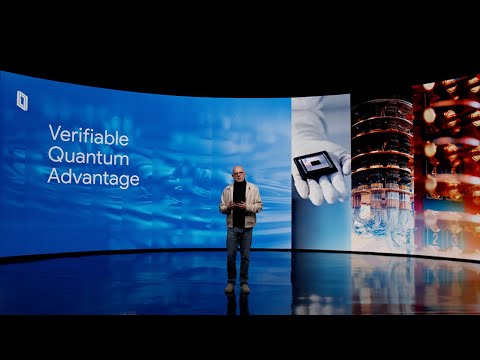
Quantum Echoes: Towards Real World Applications — Google Quantum AI Official (6:41)
🎯 Section 1: The Willow Chip — Breaking Through the Error Correction Barrier
1.1 From Sycamore to Willow: Google’s Quantum Evolution
In the five years since Sycamore achieved quantum supremacy in 2019, Quantum AI has been on a relentless march toward practical, fault-tolerant quantum computing. The December 2024 unveiling of Willow — Google’s latest 105-qubit superconducting processor — marks a watershed moment in this journey: the first time any quantum system has achieved exponential error reduction as it scales up in size.
This breakthrough, published in Nature, represents the culmination of decades of theoretical work on quantum error correction. Willow’s achievement of below-threshold error correction means that as Google adds more qubits to create larger logical qubits, errors decrease exponentially rather than increasing — a fundamental requirement for building million-qubit fault-tolerant quantum computers.
(Superconducting)
(Quantum Echoes)
vs 5 Minutes (Quantum)
(State of the Art)
1.2 Technical Architecture: How Willow Works
Superconducting Qubits: Willow uses transmon-style superconducting qubits cooled to 15 millikelvin — colder than outer space — to exploit quantum mechanical effects. Each qubit is a tiny superconducting loop interrupted by a Josephson junction, forming an anharmonic oscillator that can exist in superposition states.
Surface Code Error Correction: The Willow team implemented two distance-7 and distance-5 surface code logical qubits, demonstrating that larger logical qubits (d=7 with 49 data qubits) exhibit half the error rate of smaller ones (d=5 with 25 data qubits). This exponential improvement is the holy grail of quantum error correction — it means scaling works.
🔑 Key Breakthrough: Real-Time Decoding
Willow’s error correction decoder operates in real-time — it can identify and correct errors faster than they accumulate. The system uses a custom real-time decoder that processes syndrome measurements with microsecond latency, essential for maintaining logical qubit coherence during long computations.
Qubit Quality Improvements: Willow achieves T1 coherence times approaching 100 microseconds, up from ~50 microseconds in previous generations. Two-qubit gate error rates are around 0.15% median, with the best gates reaching 0.10% — approaching the surface code threshold of ~1%.
1.3 Random Circuit Sampling: The Ultimate Benchmark
To demonstrate Willow’s computational power, Google ran a Random Circuit Sampling (RCS) benchmark — a problem specifically designed to be hard for classical computers but tractable for quantum systems. Willow completed the RCS computation in under 5 minutes, a task that would take the world’s fastest supercomputer 10 septillion (1025) years — far longer than the age of the universe.
This isn’t just a parlor trick. RCS serves as a rigorous stress test of quantum hardware, requiring precise control over all qubits simultaneously while maintaining quantum coherence throughout the computation. Google’s ability to run RCS at this scale demonstrates that Willow has crossed a critical threshold in quantum control.

Google’s Quantum Computer Makes Breakthrough — CBS News Coverage (2:59)
🚀 Section 2: Quantum Echoes — Verifiable Quantum Advantage
2.1 Beyond Quantum Supremacy: Real-World Applications
While quantum supremacy (now often called “quantum advantage”) proved that quantum computers can outperform classical systems on some tasks, critics pointed out that RCS has no practical use. The October 2025 announcement of Quantum Echoes changes everything: Google demonstrated verifiable quantum advantage on a scientifically useful problem.
The Quantum Echoes algorithm simulates the dynamics of quantum systems to measure out-of-time-order correlators (OTOCs) — a quantity that reveals how quantum information scrambles in many-body systems. This problem is directly relevant to:
- Nuclear Magnetic Resonance (NMR) spectroscopy: Extending NMR techniques to probe complex molecular dynamics
- Condensed matter physics: Understanding quantum chaos and thermalization in materials
- Quantum gravity research: Studying black hole information paradoxes and holographic duality
- Drug discovery: Simulating protein folding and molecular interactions
(Willow Processor)
(Frontier at ORNL)
(Verifiable)
(OTOC Simulation)
2.2 The Science Behind Quantum Echoes
The Quantum Echoes algorithm leverages symmetry protection and post-selection techniques to amplify the quantum signal of OTOC(2) interference effects. Here’s why it’s so powerful:
- Verifiability: Unlike RCS, classical computers can verify Quantum Echoes results on smaller instances, providing confidence in larger calculations
- Scientific utility: The algorithm solves problems physicists actually care about, not synthetic benchmarks
- Scalability: The exponential quantum advantage grows with problem size, making larger quantum systems increasingly valuable
- Robustness: The algorithm is resilient to noise, achieving signal-to-noise ratios of 2-3 even on noisy intermediate-scale quantum (NISQ) hardware
The October 2025 demonstration ran Quantum Echoes on a 65-qubit subset of Willow’s processor, completing the simulation in 2.1 hours versus 3.2 years for the Frontier supercomputer at Oak Ridge National Laboratory — the world’s fastest classical supercomputer. Crucially, Google could verify the quantum results against classical simulations on smaller instances, confirming accuracy.
“Quantum Echoes represents the first time we’ve achieved verifiable quantum advantage on a scientifically useful problem. This is the moment the field has been waiting for — quantum computers solving real problems faster than classical systems, with results we can trust.”
— Hartmut Neven, Director of Google Quantum AI
2.3 Implications for Near-Term Applications
The Quantum Echoes breakthrough opens the door to practical quantum advantage in the 2026-2029 timeframe for specific applications:
- Materials science: Simulating phase transitions and exotic quantum materials
- Drug discovery: Modeling protein-ligand interactions and reaction pathways
- Quantum chemistry: Calculating molecular properties for catalysis and energy storage
- Condensed matter physics: Understanding high-temperature superconductivity and topological materials
Google estimates that quantum-enhanced NMR spectroscopy could become practical within five years, enabling pharmaceutical companies to probe molecular structures and dynamics in ways impossible with classical methods.
Google’s Quantum Computer Just Changed Everything — 13,000× Faster Than Supercomputers! (3:15)
🗺️ Section 3: The Five-Stage Roadmap to Quantum Utility
3.1 Google’s Framework for Quantum Application Development
In November 2025, Google Quantum AI published a five-stage framework outlining the path from abstract quantum algorithms to deployed real-world applications. This roadmap, detailed in arXiv:2511.09124, provides the most comprehensive vision yet for how quantum computing will transition from research labs to production environments.
Goal: Develop new quantum algorithms that offer theoretical exponential or polynomial speedups over classical methods.
Status: Hundreds of algorithms published; major milestones include Shor’s algorithm (factoring), Grover’s algorithm (search), HHL algorithm (linear systems), and variational quantum eigensolvers (VQE) for chemistry.
Challenges: Many algorithms require fault-tolerant hardware; unclear which will prove useful in practice.
Goal: Identify concrete problem instances where quantum advantage can be demonstrated and verified against classical methods.
Status: ✅ Achieved with Quantum Echoes (October 2025): First verifiable quantum advantage on a scientifically useful problem — OTOC simulation with 13,000× speedup.
Key Insight: Focus on problems where quantum results can be verified classically on smaller instances, then scale to regimes where classical simulation becomes impossible.
Goal: Connect Stage II problem instances to specific real-world use cases that deliver economic or scientific value.
Status: 🔄 In Progress: Quantum Echoes enables NMR spectroscopy extensions; pharmaceutical and materials science partnerships being formed.
Challenge: “Knowledge gap” between quantum algorithm developers and domain experts (chemists, materials scientists, drug designers). AI being explored as a bridge to scan literature and identify connections.
Timeline: Google estimates first real-world quantum advantage applications in 5 years (2030) for quantum-enhanced sensing and molecular simulation.
Goal: Perform detailed resource estimation — how many logical qubits, gates, runtime, and error rates are required for production deployment.
Example: Simulating FeMoco (iron-molybdenum cofactor in nitrogenase enzyme) for fertilizer applications originally required 1011 Toffoli gates and 109 physical qubits (2010 estimates). By 2025, improved algorithms reduced this to 108-109 gates and 106 qubits — still daunting but approaching feasibility.
Focus: Algorithm optimization, circuit compilation, error correction code selection, hardware-software co-design.
Timeline: Mid-2020s to early 2030s as fault-tolerant systems come online.
Goal: Integrate quantum computers into production workflows alongside classical HPC, cloud infrastructure, and domain-specific software stacks.
Requirements: Quantum advantage on full end-to-end application (not just a computational subroutine); scalable access via cloud APIs; trained workforce; regulatory frameworks.
Status: 🔮 Future (2030s): No applications have reached Stage V yet. Google Quantum AI, IBM Quantum, and other vendors building cloud infrastructure in anticipation.
3.2 The “Algorithm-First” Approach
Google’s roadmap emphasizes an algorithm-first development strategy: start with Stage II (finding verifiable quantum advantage on problem instances) rather than jumping straight to Stage III use case identification. Why?
- Verification is critical: Without the ability to verify quantum results, you can’t trust them for high-stakes applications
- Knowledge gaps exist: Quantum researchers often lack domain expertise, and vice versa — finding connections requires systematic exploration
- Serendipity matters: Some of the best applications may come from unexpected connections (e.g., Quantum Echoes enabling NMR extensions wasn’t obvious a priori)
- Resource estimates evolve: Stage IV optimization can reduce resource requirements by orders of magnitude, making previously impossible applications feasible
🤝 Bridging the Knowledge Gap with AI
Google is exploring using large language models (LLMs) to bridge the knowledge gap between quantum algorithm researchers and domain experts. By training AI systems to scan physics, chemistry, and materials science literature, they hope to automatically identify connections between quantum algorithms (Stage II) and real-world problems (Stage III). This “AI for quantum application discovery” initiative represents a meta-level innovation in quantum computing development.
💻 Section 4: The Software Stack — Cirq and Google Quantum AI Platform
4.1 Cirq: Google’s Open-Source Quantum Framework
Cirq is Google’s Python library for writing, simulating, and running quantum circuits on Google’s quantum processors and other supported hardware. Released in 2018 and actively developed through 2025, Cirq has become one of the most popular quantum programming frameworks alongside IBM’s Qiskit and Rigetti’s PyQuil.
Key Features:
- Native gate set support: Cirq is designed for near-term quantum hardware, with native support for the gate sets used on Google’s superconducting processors (e.g., √iSWAP, sycamore gates)
- Realistic noise modeling: Built-in noise models for superconducting qubits, including T1/T2 decoherence, gate errors, and measurement errors
- Custom circuit compilation: Fine-grained control over circuit compilation and optimization for specific hardware topologies
- Integration with TensorFlow Quantum: Seamless interop with TensorFlow Quantum for hybrid quantum-classical machine learning
- Cloud access: Direct integration with Google Quantum AI quantum processors via Google Cloud
| Framework | Company | Primary Hardware | Language | Key Strengths |
|---|---|---|---|---|
| Cirq | Superconducting qubits (Sycamore, Willow) | Python | Near-term NISQ focus; TensorFlow integration; realistic noise models | |
| Qiskit | IBM | Superconducting qubits (Heron, Condor) | Python | Largest ecosystem; extensive algorithms library; cloud access |
| PennyLane | Xanadu | Photonic (Borealis); agnostic plugins | Python | Quantum machine learning focus; autodiff; hardware-agnostic |
| Q# | Microsoft | Topological qubits (future); simulators | Q# (C#-like) | Fault-tolerant focus; resource estimation; Azure integration |
| Braket SDK | Amazon | Hardware-agnostic (IonQ, Rigetti, OQC) | Python | Multi-vendor access; AWS ecosystem; pay-per-shot pricing |
4.2 Google Quantum AI Platform: Cloud Access
Researchers and developers can access Google’s quantum processors via Google Cloud using Cirq. As of 2025, Google provides:
- Quantum Computing Service: API access to Google’s quantum processors with quota-based allocation
- Quantum simulators: High-performance classical simulators for circuits up to ~30-40 qubits
- Research partnerships: Google Quantum AI partners with academic institutions and companies to provide dedicated quantum processor time for research projects
- Educational resources: Tutorials, codelabs, and learning materials for quantum computing education
Unlike IBM’s open Quantum Network approach (which provides free public access to some systems), Google’s quantum hardware access is more restricted, typically requiring research partnerships or commercial agreements. However, Google compensates with extensive educational resources and simulator access.
4.3 The Quantum AI Campus: Infrastructure at Scale
Google’s Quantum AI Campus in Santa Barbara, California, is one of the world’s most advanced quantum computing facilities. Unveiled in 2021 and expanded through 2025, the campus features:
- Dedicated fabrication facilities: Custom superconducting qubit fabrication cleanrooms optimized for rapid prototyping
- Cryogenic infrastructure: Dozens of dilution refrigerators cooling quantum processors to 15 millikelvin
- Control electronics: Room-temperature control systems with real-time feedback for error correction
- Data center integration: Co-located classical HPC for hybrid quantum-classical algorithms and simulation
The campus represents over $1 billion in infrastructure investment and employs hundreds of researchers, engineers, and technicians working on quantum hardware, software, algorithms, and applications.
How to Program a Quantum Computer Using Cirq — IBM Technology Tutorial (6:00)
🔮 Section 5: 2026-2029 Projections — The Path to Fault Tolerance
5.1 Hardware Roadmap: Beyond Willow
While Google hasn’t publicly released a detailed post-Willow hardware roadmap (unlike IBM’s detailed Nighthawk → Kookaburra → Cockatoo → Starling plan), industry analysts and Google publications suggest the following trajectory:
Goal: Demonstrate 10-20 logical qubits operating simultaneously with below-threshold error correction.
Hardware: ~500-1000 physical qubit processor optimized for surface code; improved connectivity for magic state distillation.
Milestone: Run small-scale fault-tolerant algorithms (e.g., quantum phase estimation on small molecules) with logical qubits.
Goal: Develop modular quantum computing architecture with multiple connected quantum processors.
Hardware: Quantum interconnects enabling communication between separate quantum processors; each module contains 100-500 qubits.
Milestone: Demonstrate distributed quantum computing with logical qubits shared across modules.
Goal: Reach 100+ logical qubits capable of running scientifically useful fault-tolerant algorithms.
Hardware: 10,000+ physical qubit system with advanced error correction codes (possibly beyond surface codes; e.g., low-density parity-check codes).
Applications: Quantum chemistry simulations for drug discovery; materials science; optimization problems in logistics and finance.
5.2 Algorithm Development: From NISQ to Fault-Tolerant
Google’s algorithm development strategy bridges the gap between noisy intermediate-scale quantum (NISQ) devices like Willow and future fault-tolerant systems:
- 2025-2026: NISQ Applications: Focus on variational quantum algorithms (VQA) that are noise-resilient: variational quantum eigensolvers (VQE), quantum approximate optimization algorithm (QAOA), quantum machine learning (QML) applications
- 2026-2027: Error-Mitigated NISQ: Combine NISQ hardware with error mitigation techniques (zero-noise extrapolation, probabilistic error cancellation) to extend utility without full error correction
- 2027-2029: Early Fault-Tolerant: Run small-scale fault-tolerant algorithms on 10-100 logical qubits: quantum phase estimation, quantum chemistry simulations, quantum search on structured problems
- 2029+: Utility-Scale Fault-Tolerant: Target problems requiring 100-1000 logical qubits: cryptography (Shor’s algorithm), materials discovery, drug design, financial modeling
5.3 Application Focus Areas
Based on Google’s five-stage roadmap and Quantum Echoes breakthrough, the company is prioritizing the following application verticals for 2026-2029:
(Molecular Simulation)
(Catalyst Design)
(Protein Folding)
(NMR Enhancement)
Quantum-Enhanced Sensing (2026-2030)
The Quantum Echoes algorithm directly enables quantum-enhanced NMR spectroscopy for pharmaceutical R&D. Google estimates this could become a commercially viable application within 5 years, allowing drug companies to probe molecular structures with unprecedented sensitivity.
Materials Science (2027-2031)
Simulating materials at the quantum level (superconductors, topological materials, catalysts) requires solving complex electronic structure problems. Google is partnering with materials science companies to identify target molecules where quantum simulation offers advantages over classical density functional theory (DFT) calculations.
Drug Discovery (2028-2032)
Modeling protein-ligand binding interactions, predicting drug molecule properties, and simulating biochemical reaction pathways are grand challenges in computational biology. Google is working with pharmaceutical partners to develop quantum algorithms for these problems, though most applications require fault-tolerant systems with 100+ logical qubits.
Optimization (2029+)
While QAOA (quantum approximate optimization algorithm) can run on NISQ hardware, achieving quantum advantage on real-world optimization problems (logistics, portfolio optimization, supply chain) likely requires fault-tolerant systems. Google is exploring hybrid quantum-classical approaches in partnership with Google Cloud customers.
5.4 Competitive Landscape: Google vs. IBM vs. Atom Computing vs. IonQ
| Company | 2025 Status | 2026-2029 Roadmap | Key Strengths | Challenges |
|---|---|---|---|---|
| Google Quantum AI | Willow 105 qubits; below-threshold QEC; 13,000× advantage | Modular architecture; 100+ logical qubits by 2029 | First below-threshold QEC; Quantum Echoes verifiable advantage; deep AI/ML expertise | Limited external access; smaller qubit count vs IBM; tight ecosystem control |
| IBM Quantum | Nighthawk 120q (late 2025); Loon QEC demo; Starling roadmap to 2029 | 200 logical qubits by 2029; 100M gates; utility-scale FTQC | Detailed public roadmap; open cloud access; largest quantum network (200+ partners) | QEC not yet below-threshold; competing with own classical business; slower gate times |
| Atom Computing | 1,225-qubit neutral atom (2024); scaling to 1,500+ (2025) | 5,000+ qubits by 2027; fault-tolerant by 2028 | Highest raw qubit count; long coherence; reconfigurable connectivity | Gate speeds slower than superconducting; QEC immature; limited software stack |
| IonQ | IonQ Forte Forte (36 qubits, #AQ 35); Tempo (2025) targets #AQ 64+ | 100+ qubits by 2028; error-corrected logical qubits | Highest gate fidelities (99.9%+); all-to-all connectivity; long coherence | Low qubit count vs rivals; trapped-ion scaling challenges; limited algorithm demos |
| QuEra / Harvard | 256-qubit neutral atom (Aquila); analog quantum simulation | 1,000+ qubit systems; hybrid analog-digital | AWS Braket access; strong academic ties; programmable Rydberg physics | Analog-first (limited gate model); early commercialization stage; smaller company |
⚠️ The Race Is Heating Up
Google’s Willow demonstration has intensified competition in quantum computing. IBM responded with accelerated roadmap announcements (Nighthawk, Loon). Atom Computing announced partnerships with DARPA and commercial customers. IonQ raised additional funding to scale trapped-ion systems. China’s quantum efforts (Zuchongzhi, Jiuzhang photonic systems) continue advancing, though with less public detail. The 2026-2029 period will determine which companies achieve practical quantum advantage on commercially relevant problems.
🌐 Section 6: Google’s Quantum Ecosystem & Partnerships
6.1 Academic Collaborations
Google Quantum AI maintains deep ties with leading universities:
- UC Santa Barbara: Co-located campus; joint faculty appointments; PhD student pipeline
- Caltech: Collaboration on quantum error correction theory; co-authored Willow Nature paper
- MIT: Quantum algorithm development; quantum machine learning research
- Harvard: Quantum many-body physics; cold atom crossover research
- Stanford: Quantum networking; quantum cryptography research
6.2 Corporate Partnerships
Unlike IBM’s broad Quantum Network, Google pursues targeted strategic partnerships:
- Google Cloud customers: Select enterprise partners (unnamed) exploring quantum algorithms for industry-specific problems
- Pharmaceutical companies: Partnerships exploring quantum-enhanced drug discovery (details under NDA)
- Materials science firms: Collaborations on catalyst design for energy applications
6.3 Quantum AI Research Initiatives
Google leverages its AI expertise to accelerate quantum computing development:
- TensorFlow Quantum: Open-source library for hybrid quantum-classical machine learning
- AI for quantum control: Using machine learning to optimize qubit calibration and gate sequences
- LLMs for quantum application discovery: Experimental use of large language models to identify quantum-classical connections
- Quantum neural networks: Research on quantum analogs of deep learning
🎓 Interactive AI Research Prompts
🤖 Explore These Topics with AI Assistants
Copy and paste these prompts into ChatGPT, Claude, or other AI assistants to explore Google Quantum AI’s breakthroughs in depth:
“Explain how Google’s Willow chip achieves below-threshold quantum error correction using surface codes. What is the significance of the distance-7 logical qubit having half the error rate of the distance-5 logical qubit? What are the resource requirements (physical qubits, gate times, measurement cycles) for scaling surface codes to 100 logical qubits?”
“Break down Google’s Quantum Echoes algorithm for measuring out-of-time-order correlators (OTOCs). Why is this problem hard for classical computers but tractable for quantum systems? How does the algorithm achieve verifiable quantum advantage? What are the implications for NMR spectroscopy and drug discovery?”
“Compare and contrast Google’s superconducting qubit approach (Willow) with IBM’s superconducting qubits (Nighthawk), IonQ’s trapped ions, Atom Computing’s neutral atoms, and PsiQuantum’s photonics. What are the trade-offs in gate speed, coherence time, connectivity, scalability, and error correction? Which modality is most likely to achieve utility-scale quantum computing first and why?”
“Analyze Google’s five-stage framework for quantum application development (Discovery, Finding Problem Instances, Real-World Advantage, Engineering for Use, Application Deployment). What is the ‘knowledge gap’ challenge in Stage III? How is Google using AI to bridge this gap? Provide examples of algorithms at each stage as of 2025.”
“Compare Google’s Cirq framework with IBM’s Qiskit in terms of: 1) hardware abstraction and native gate set support, 2) noise modeling and simulation capabilities, 3) algorithm libraries and application focus, 4) cloud access and hardware availability, 5) developer community and ecosystem maturity. Which framework should a quantum developer choose in 2025 and why?”
“Distinguish between ‘quantum supremacy,’ ‘quantum advantage,’ and ‘verifiable quantum advantage.’ How did Google’s 2019 Sycamore demonstration (RCS in 200 seconds vs 10,000 years classical) differ from the 2025 Quantum Echoes demonstration (13,000× speedup on OTOC simulation)? Why is verifiability critical for real-world adoption? When will we see quantum advantage on commercially valuable problems?”
❓ Frequently Asked Questions (FAQ)
Key Differences:
- Error Correction Milestone: Willow is the first to demonstrate below-threshold quantum error correction (errors decrease exponentially as logical qubit size increases). IBM’s Loon processor demos key fault-tolerant components but hasn’t yet achieved full below-threshold scaling.
- Qubit Count: Willow has 105 qubits vs. IBM Nighthawk’s 120 qubits (late 2025). IBM’s Condor reached 1,121 qubits (2023) but wasn’t optimized for error correction.
- Architecture: Both use superconducting transmon qubits with surface code error correction. IBM focuses on heavy-hex lattice topology; Google uses a 2D square lattice.
- Software Stack: Google offers Cirq (more NISQ-focused, TensorFlow integration). IBM offers Qiskit (larger ecosystem, more fault-tolerant algorithms, broader cloud access).
- Openness: IBM provides extensive public quantum processor access via IBM Quantum Network (free tier + premium). Google’s hardware access is more restricted, requiring partnerships.
Bottom Line: Google leads in error correction demonstrations; IBM leads in qubit scale, public roadmap transparency, and ecosystem openness.
What It Is: Quantum Echoes is a quantum algorithm that simulates the dynamics of many-body quantum systems to measure out-of-time-order correlators (OTOCs) — quantities that reveal how quantum information scrambles in complex systems.
Why It Matters:
- First Verifiable Quantum Advantage on a Scientific Problem: Demonstrated 13,000× speedup over Frontier supercomputer on a problem physicists actually care about (not just a synthetic benchmark like Random Circuit Sampling).
- Verifiability: Classical computers can verify Quantum Echoes results on smaller instances, providing confidence in larger quantum calculations — critical for trust in quantum results.
- Near-Term Applications: Enables quantum-enhanced NMR spectroscopy within ~5 years for pharmaceutical R&D, materials characterization, and biochemistry.
- Pathway to Fault-Tolerance: Demonstrates that useful quantum algorithms exist in the NISQ regime (before full fault-tolerance), motivating near-term hardware development.
Technical Details: The algorithm uses symmetry protection and post-selection to amplify OTOC(2) interference signals. It’s resilient to noise (signal-to-noise ratio 2-3 on NISQ hardware) and scales exponentially in quantum advantage as problem size increases.
Timeline by Application Area:
- 2026-2027: Quantum-Enhanced Sensing: Google estimates quantum-enhanced NMR spectroscopy (via Quantum Echoes) could become practical within 5 years for pharmaceutical applications.
- 2027-2029: Materials Science Simulations: Quantum simulation of small molecules, catalysts, and exotic materials for companies willing to adopt early-stage technology. Requires ~50-100 logical qubits.
- 2029-2031: Drug Discovery: Quantum simulation of protein-ligand interactions, reaction pathways, and molecular properties at scale useful to pharmaceutical companies. Requires 100-500 logical qubits.
- 2031-2035: Optimization & Finance: Quantum advantage on real-world optimization problems (logistics, portfolio optimization, supply chain). Requires 500-1,000 logical qubits and sophisticated error correction.
- 2035+: Cryptography: Shor’s algorithm breaking RSA encryption (requires millions of physical qubits, thousands of logical qubits). Post-quantum cryptography will be widely deployed by then, mitigating the threat.
Caveats: These timelines assume continued exponential progress in error correction, qubit scaling, and algorithm development. Unexpected breakthroughs (e.g., better error correction codes, algorithmic improvements) could accelerate timelines; unforeseen roadblocks could delay them.
Roadmap Transparency:
- IBM: Most transparent — detailed public roadmap through 2029 (Nighthawk → Kookaburra → Cockatoo → Starling) with specific qubit counts, gate counts, and error correction milestones.
- Google: Less specific post-Willow roadmap publicly available. Five-stage application framework provides strategic direction but lacks hardware milestone details.
- Atom Computing: Announced scaling to 5,000+ qubits by 2027 and fault-tolerance by 2028 (neutral atoms). Ambitious but less detailed on error correction specifics.
- IonQ: Roadmap focuses on algorithmic qubit (#AQ) metric scaling; targeting #AQ 64+ by 2025, 100+ by 2028. Less emphasis on raw qubit count.
Technical Approach:
- Google & IBM: Both pursue superconducting qubits with surface code error correction — similar paths with different execution details.
- Atom Computing & QuEra: Neutral atoms offer higher qubit counts and long coherence but slower gates and less mature error correction.
- IonQ & Honeywell/Quantinuum: Trapped ions offer highest gate fidelities (99.9%+) and all-to-all connectivity but face scaling challenges.
- PsiQuantum & Xanadu: Photonic approaches promise room-temperature operation and networked architectures but require millions of physical qubits for fault-tolerance.
Bottom Line: Google’s strength is demonstrated below-threshold error correction and verifiable quantum advantage. IBM’s strength is transparent roadmap and open ecosystem. Atom Computing leads in raw qubit count. IonQ leads in gate fidelity. 2026-2029 will determine which approach scales most effectively.
Google Quantum AI Access:
- Research Partnerships: Primary access route. Google collaborates with academic institutions and select companies on quantum research projects, providing dedicated processor time.
- Google Cloud (Limited): Some quantum computing services via Google Cloud, but access to cutting-edge hardware (like Willow) is restricted.
- Cirq Simulators: Open-source simulators available free via Cirq for circuits up to ~30-40 qubits (depending on entanglement).
- Educational Resources: Extensive tutorials, codelabs, and documentation at quantumai.google.
IBM Quantum Access (More Open):
- Free Tier: IBM Quantum Network offers free access to select quantum processors (typically 5-7 qubits and some 27-qubit systems) for anyone who signs up.
- Premium Access: IBM Quantum Premium provides access to cutting-edge systems (Heron, Nighthawk) for paying customers and premium research partners.
- Cloud Simulators: High-performance simulators available via IBM Quantum Platform.
- Largest Ecosystem: 200+ members in IBM Quantum Network including universities, national labs, Fortune 500 companies.
Other Options:
- Amazon Braket: Multi-vendor access (IonQ, Rigetti, OQC, QuEra) via AWS with pay-per-shot pricing.
- Microsoft Azure Quantum: Access to IonQ, Quantinuum, Rigetti via Azure cloud.
- IonQ Cloud: Direct access to IonQ’s trapped-ion systems.
Recommendation: For learning quantum programming, start with IBM’s free tier (Qiskit) or AWS Braket. For cutting-edge research, pursue academic partnerships with Google or IBM. For commercial exploration, evaluate AWS Braket or IBM Quantum Premium based on algorithm needs.
What “Below-Threshold” Means: In quantum error correction, the “threshold” is the maximum physical qubit error rate below which adding more qubits to a logical qubit decreases the logical error rate rather than increasing it. For surface codes, the theoretical threshold is around 1% per gate.
Why It’s Hard: Historically, every quantum system saw logical error rates increase when scaling up logical qubits (more qubits = more errors accumulating). This created a vicious cycle preventing progress toward fault-tolerance.
Willow’s Achievement: Google demonstrated that a distance-7 logical qubit (49 data qubits) has half the error rate of a distance-5 logical qubit (25 data qubits) — exponential improvement. This is the first time any quantum system has crossed the below-threshold barrier.
Why It’s Significant:
- Validates Error Correction Theory: Proves that surface code quantum error correction works in practice, not just in theory.
- Enables Scaling: With below-threshold performance, Google can now scale to 100, 1,000, 10,000+ qubit systems with confidence that logical error rates will continue decreasing.
- Path to Fault-Tolerance: Below-threshold QEC is a prerequisite for building utility-scale fault-tolerant quantum computers capable of running Shor’s algorithm, large-scale quantum chemistry, etc.
- Competitive Milestone: Google is the first to demonstrate this publicly. IBM’s Loon processor demos key components but hasn’t yet shown exponential scaling across multiple code distances.
What’s Next: Google must now demonstrate 10-20 logical qubits operating simultaneously, long-duration logical operations (thousands of error correction cycles), and universal logical gate sets (not just memory). These are the next milestones toward fault-tolerant quantum computing.
🎯 Conclusion: Google’s Quantum Supremacy… and What Comes Next
Google Quantum AI’s 2025 achievements — Willow’s below-threshold error correction and Quantum Echoes’ verifiable quantum advantage — represent inflection points in quantum computing history. For the first time, we have proof that quantum error correction scales as theory predicts, and evidence that quantum computers can solve scientifically useful problems faster than classical supercomputers.
Yet challenges remain. Willow’s 105 qubits and 2-3 logical qubits are a long way from the 100-1,000 logical qubits needed for transformative applications. The Quantum Echoes algorithm, while groundbreaking, applies to a narrow class of physics simulations. Google’s five-stage roadmap acknowledges the “knowledge gap” challenge: connecting quantum algorithms to real-world use cases requires interdisciplinary collaboration that has barely begun.
The 2026-2029 window will be decisive. Google must translate Willow’s error correction breakthrough into 10-100 logical qubit systems while IBM scales its Starling roadmap to 200 logical qubits. Atom Computing and IonQ will push alternative qubit modalities toward utility scale. Startups like PsiQuantum (photonics) and Rigetti (superconducting) will pursue niche advantages. China’s quantum efforts, while less transparent, continue advancing rapidly.
The race to fault-tolerant quantum computing is no longer a question of if but when — and which company gets there first. Google’s algorithm-first approach, deep AI expertise, and Santa Barbara infrastructure position it as a frontrunner. But IBM’s open ecosystem, detailed roadmap, and Quantum Network partnerships offer a competing vision of broad-based quantum innovation.
For developers, researchers, and companies: Now is the time to engage. Learn quantum programming via Cirq or Qiskit. Explore potential quantum algorithms for your domain. Partner with quantum vendors to identify Stage III use cases. The companies that understand quantum’s strengths and limitations today will be positioned to exploit quantum advantage when it arrives in the late 2020s and early 2030s.
The quantum computing revolution is no longer hypothetical. It’s here — and accelerating.
📚 Sources & References
- Google Quantum AI Blog: Meet Willow, our state-of-the-art quantum chip (December 9, 2024)
- Nature Publication: Quantum error correction below the surface code threshold
- Google Research Blog: Making quantum error correction work
- Google Quantum AI Blog: The Quantum Echoes algorithm breakthrough (October 22, 2025)
- Nature Publication: Verifiable quantum advantage in physics simulation
- Google Quantum AI: Five-Stage Roadmap to Quantum Utility (November 13, 2025)
- arXiv Preprint: The Grand Challenge of Quantum Applications
- Google Quantum AI: Cirq: Python Framework for Quantum Computing
- Google Quantum AI: Our Lab — Quantum AI Campus
- The Quantum Insider: Google Quantum AI Shows 13,000× Speedup Over World’s Fastest Supercomputer
- CBS News: Google’s quantum computer makes breakthrough
- Forbes: Google AI Outlines Five-Stage Roadmap to Make Quantum Computing Useful
Article #2 of 20 in the Top 20 Quantum Computing Companies Deep Dive Series
Next: Article #3 — IonQ: Trapped-Ion Quantum Computing & The Quest for #AQ 100
Previous: Article #1 — IBM Quantum Deep Dive 2025

Kristof George AI Strategist, Fintech Consultant & Publisher of QuantumAI.co
Kristof George is a seasoned digital strategist and fintech publisher with over a decade of experience at the intersection of artificial intelligence, algorithmic trading, and online financial education. As the driving force behind QuantumAI.co.com, Kristof has curated and published hundreds of expert-reviewed articles exploring the rise of quantum-enhanced trading, AI-based market prediction systems, and next-gen investment platforms.
Why Trust Kristof George?
✅ Experience: 10+ years in fintech publishing, affiliate compliance, and AI content development.
🧠 Expertise: Deep knowledge of algorithmic trading platforms, quantum computing trends, and the evolving regulatory landscape.
🔍 Authoritativeness: Cited across industry blogs, crypto review networks, and independent watchdog forums.
🛡 Trustworthiness: Committed to fact-checking, scam exposure, and promoting ethical AI adoption in finance.
